
 Did you know that October is American Archives Month? Each October since 2006, archives and special collections across the United States throw open their doors and show off the amazing “stuff” (Yes, that IS a technical term!) in their collections while educating the public about what archivists do; why archives are important to society’s past, present, and future; and how these materials are made accessible to anyone who wishes to use them. You can check out some of the great events planned for Archives Month Philly here.
The Skin She Lived In: Anthropodermic Books in the Historical Medical Library
-by Beth Lander
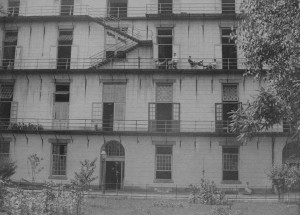
On Wednesday, July 15, 1868, a 28 year old woman named Mary Lynch was admitted to Old Blockley, Philadelphia’s almshouse, officially known as Philadelphia General Hospital (PGH). Old Blockley was located at what is now the intersection of 34th Street and Civic Center Boulevard, on the southeast corner of the University of Pennsylvania. Blockley was where you went when you could not afford care in a private hospital.
The Women’s Receiving Register from PGH lists a small amount of information for each patient: name, birthplace (a country, if other than the United States. Mary was born in Ireland.), age, temperate or intemperate habits (Were you a drunk, or not?), date of admission, ward, color and diagnosis.
Mary suffered from phthitis, an archaic term for tuberculosis of the lungs. She was listed as being of temperate habits.
Welcome to this inaugural edition of Fugitive Leaves…
…the blog of the Historical Medical Library of The College of Physicians of Philadelphia (HML). In the tradition of the Transactions and Studies of The College of Physicians of Philadelphia, the blog will highlight the history of medicine and related fields through the work of the scholars we are privileged to host. The blog will also highlight the work of Library staff as well as the unique and wondrous, mundane and ephemeral, aspects of the Library collection, a collection that provides us with endless fascination.
We look forward to your thoughts and comments – the history of medicine is nothing if not a dialogue between what is and what could be. We welcome your participation in that dialogue!
With this inaugural post, we would like to share some exciting news: the HML is home to the largest collection of confirmed anthropodermic books in the country.
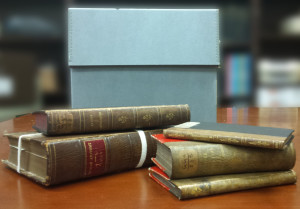
This past March the Historical Medical Library (HML) hosted Dr. Richard Hark, the H. George Foster Chair of Chemistry at Juniata College, who came to take minute samples of book bindings purported to be anthropodermic – bound in human skin. Samples were taken, and testing was conducted by Dr. Daniel Kirby, a Conservation Scientist in private practice.
Dr. Kirby used peptide mass fingerprinting (PMF), a method used “to identify mammalian sources of collagen.” PMF does not look at DNA; rather, “enzymatic digestion is used to cleave collagen at specific amino acid sites forming a mixture of peptides. The amino acid sequence of each protein is unique, thus the resultant mixture of peptides is unique.” Drs. Hark and Kirby presented their findings on September 29th at SciX, a conference dedicated “to the analytical sciences, instrumentation and unique applications,” at which they confirmed that the HML is home to five samples of anthropodermic bibliopegy, the largest such confirmed collection in the United States.
The most intriguing aspect of three of these five books is that we not only know who bound the books, but we also know from whom the skin was taken. What follows is the story of Dr. John Stockton Hough and Mary Lynch, a young medical student and a poor Irish immigrant, whose encounter in 1869 led to the creation of the most unique books.
-by Beth Lander, College Librarian
The Skin She Lived In: Anthropodermic Books in the Historical Medical Library
On Wednesday, July 15, 1868, a 28 year old woman named Mary Lynch was admitted to Old Blockley, Philadelphia’s almshouse, officially known as Philadelphia General Hospital (PGH). Old Blockley was located at what is now the intersection of 34th Street and Civic Center Boulevard, on the southeast corner of the University of Pennsylvania. Blockley was where you went when you could not afford care in a private hospital.
The Women’s Receiving Register from PGH lists a small amount of information for each patient: name, birthplace (a country, if other than the United States. Mary was born in Ireland.), age, temperate or intemperate habits (Were you a drunk, or not?), date of admission, ward, color and diagnosis.
Mary suffered from phthitis, an archaic term for tuberculosis of the lungs. Read more…
Exploring Herbal Medicine

Herbal medicine has been in use for millennia, with some of the earliest recorded instances being found in the ancient East, Middle East, and the Egyptians. Ancient Greeks and Romans relied on herbs for their healing properties, and early scholars like Aristotle (384 – 322 B.C.E.) and Theophrastus (371 – 287 B.C.E.) wrote about these plants and their healing properties. De materia medica (Latin for “medical material”) by Pedanius Dioscorides, written sometime between 50 and 75 C.E., is an early example of an encyclopedia and pharmacopoeia. Books like this would contain descriptions of plants, their traits, and recipes for medicinal use.
During the Middle Ages, herbal medicine was still a common form of treatment. The first printed books about it, called herbals, were printed in the late 15th century. Herbals contain illustrations or woodcuts of plants along with descriptions, traits, and medicinal recipes. Herbals remained popular well into the 19th century. The first synthetic drug was discovered and 1869, and synthetic drugs became more widely used during the next century and a half.
Near the end of the 20th century, more people began looking for alternatives to synthetic drugs and “re-discovered” herbal medicine. Today, many stores offer plant-based medicines and more medical practices offer integrative or alternative care.
The links below will direct you to the catalog record or finding aid of the resource listed. Remember to check our library catalog and finding aids – these are only some of the great sources we have about herbal medicine!
Primary sources
 Edgar Hewish recipe book of medical remedies and household mixture, undated
Call number: 10a 434
Timothy Hall recipe book, 1823-1834
Call number: MSS 2/0285-01
A course of fifteen lectures on medical botany…
by Samuel Robinson, 1834
Call number: Qk 4b
 The sick man’s friend. Being a plain, practical medical work; designed for the use of families and individuals on vegetable, or botanical principles
by P.E. Sanborn, 1836
Call number: Qk 25
Paul Goddard “receipt” (recipe) book, circa 1857
Call number: 10a 43
Madame Young’s guide to health: her experience and practice for nearly forty years, a true family herbal ….
by Amelia Young, 1858
Call number: WB 120 Y68m 1858
 Photograph: Medicinal herb peddler, circa 1870
Call number: Picture file #2
Meals medicinal: with “herbal simples, ” (of edible parts) curative foods from the cook; in place of drugs from the chemist
by William Thomas Fernie, 1905
Call number: Qd 80
Herbs for health; a concise treatise on medicinal herbs, their usefulness and correct combination in the treatment of diseases. A guide to health by natural means. With many black and colored illustrations
by Otto Mausert, circa 1932
Call number: Yb 54
The green pharmacy: new discoveries in herbal remedies for common diseases and conditions from the world’s foremost authority on healing herbs
by James A. Duke, 1997
Call number: WB 925 D877g 1997
Secondary sources
Herbals, their origin and evolution: a chapter in the history of botany, 1470-1670
by Agnes Robertson Arber, 1938
Call number: QK 15 A664h 1938
Nature’s medicines: the folklore, romance, and value of herbal remedies
by Richard Lucas, 1966
Call number: Qb 121
*Content written by Chrissie Perella, Archivist