I arrived in Philadelphia on a beautiful clear afternoon in October. After Hurricane Joaquin grazed the city a few days before, the buildings looked freshly washed and the light remained watery. I was in Philadelphia with the help of a Wood Institute Travel Grant from the College of Physicians to facilitate research toward my current creative project, “The Cage Went in Search of a Bird.” This project explores how tuberculosis captured America’s collective cultural imagination during the 19th century, creating an image of an illness that affected both the body and the spirit. I hoped to find texts in the Historical Medical Library focused on the treatment of the disease in the 19th century and then explore any breathing devices or other medical apparatus developed to treat tuberculosis that was housed in the Mütter Museum’s collections.
Every librarian has come across a particular collection and has wondered what librarians in the past were thinking. The most recent such example at the Historical Medical Library of The College of Physicians of Philadelphia contains 700 boxes filled with uncatalogued reprints, medical trade ephemera and pamphlets. How and why did we end up with nearly 70,000 uncatalogued items?
Book Exchanges
Example of a book plate indicating exchange in the collection
Book and reprint exchanges were a very popular method for medical libraries to accumulate texts for their physicians without making purchases. At the head of the exchange was the Medical Library Association’s (MLA) founder and College of Physicians of Philadelphia Fellow, George M. Gould. Dr. Gould preached that resource sharing among libraries was the best way to advance knowledge for doctors. MLA’s original intent was for libraries to share their duplicate medical literature. This caused libraries to be proactive in asking for prints from publishers and for reprints from journals so they could trade them later for material they did not have. In 1890, libraries started to see increased cooperation with publishers and among each other – this is where our collection of reprints and pamphlets begins. In 1930, there is a shift from exchanging modern periodicals and pamphlets to exchanging medical treatises. This marks the end of the formation of this pamphlet and reprint collection. It can be concluded from looking at the Library’s history, and trends in medical publishing, that many of these pamphlets and reprints derive from these book exchanges.
Our pop-up exhibits have been received with enthusiasm and we love surprising Museum visitors with the opportunity to visit the Library and see our collections. The exhibits in October were focused on the concept of “monster” as used as a medical term over the past 500 years, and culminated in our Archives Month Philly event, “The Monstrous, Fabled & Factual: Exploring the Meaning of ‘Monster,’ 1500-1900.” (You can read our previous post about Archives Month here.) The exhibits in November displayed our “Favorite Things.”
This year was our first time participating in Archives Month Philly. It was fantastic to invite everyone, show off our collections, and talk about them with our peers. We feel like our Library has been “hidden” for so long – especially to the general public – and Archives Month was the perfect opportunity to show people that we exist and have interesting collections!
Starting in March 2015, the Historical Medical Library of The College of Physicians of Philadelphia (HML) embarked on its second large scale digitization project. Under grants from the National Endowment for the Humanities and the Arcadia Foundation, and in conjunction with our partners at the Medical Heritage Library (MHL), a digital curation collaborative, we are working to digitize the entirety of State Medical Society Journals published in the US throughout the 20th Century.
The culmination of the project will be over 2.5 million pages of fully searchable digitized content. Patrons will be able to access this material through the MHL, as well as the Internet Archive, whose facilities in Princeton will be doing the digitization. This will be the first time that all of this content will be available in one place, either in print or digitally.
A selection of State Medical Society Journals on the shelf in our stacks.
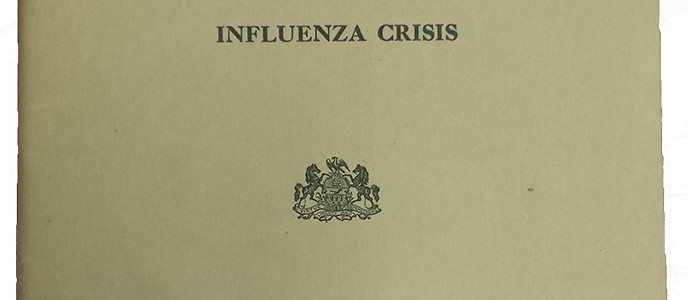
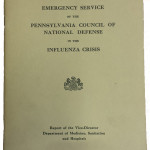
Pennsylvania Council of National Defense Department of Medicine, Sanitation and Hospitals. Emergency Service of the Pennsylvania Council of National Defense in the Influenza Crisis. Harrisburg, PA. 1918. Call number: Pam 173
The 1918 influenza pandemic did not hit the world all at once, but rather in three waves throughout 1918 and into 1919. Though it is unclear how the influenza pandemic influenced the outcome of World War I, what is undeniable is the pandemic’s connection to the war itself.
The first wave was in early 1918, and may have originated in Haskell County, Kansas, where “18 cases of influenza of a severe type” were reported in January and February. From Camp Funston in Fort Riley, Kansas, influenza travelled to Europe with soldiers going to the battlefront of World War I. The general population picked the disease up from the military, and by June, it was epidemic among the German troops and appearing among civilians in mainland Britain. While this first wave did substantial damage, it was milder than and not nearly as lethal as the second wave, which appeared as the first wave was fading in late August.
The second wave began when three cities on three separate continents experienced outbreaks of influenza almost simultaneously. Boston, Massachusetts in North America; Brest, France in Europe; and Freetown, Sierra Leone in Africa all had influenza appear in their naval yards between August 22 and August 27, 1918. The first cases of influenza in Philadelphia appeared on September 7, when sailors from Boston arrived in the naval yard. By early October, hospital beds in Philadelphia were full, public meetings and church services were banned, schools were closed, and there was a severe shortage of coffins. Beginning in September 1918 and until spring of 1919, the weekly number of influenza-related deaths in Philadelphia dropped below three figures only once. In October alone, over 11,000 Philadelphians died from influenza.
By the end of October, public services and meetings, including school and church, were re-opened. In early November, influenza in Philadelphia had reached its peak and the number of deaths slowly declined. A reported 12,162 people had died by November 2, 1918. The end of the second wave for most American cities, including Philadelphia, came in mid-November. Philadelphia had a small resurgence during the third and final wave during February 1919. By the end of the pandemic, a huge number of people had died. A general estimate for the total number of deaths is 50 million, though estimates range from as low as 25 million to as high as 100 million deaths worldwide. Over 1.5 million of these deaths were in the United States. Whichever way the true numbers run, the loss of life is truly astounding.
The links below will direct you to the catalog record or finding aid of the resource listed. Remember to check our library catalog and finding aids – these are only some of the great sources we have about the influenza pandemic!
Primary sources
Note: Some of these materials are uncatalogued and are not linked to a catalogue record. When requesting the uncatalogued materials, please be sure to include all of the information shown here.
by Karie Youngdahl, Project Director, History of Vaccines
Robert Abbe (1851-1928), a New York surgeon and Fellow of The College of Physicians of Philadelphia, was an avid collector of medical and archaeological objects. Here at the College’s Historical Medical Library, we hold a number of Abbe’s items, including mementos from his friendship with Marie Curie. Of particular interest to the History of Vaccines project is Abbe’s collection of Louis Pasteur memorabilia, much of it dating from the 1922 centenary celebrations of Pasteur’s birth.
The collection includes a scrapbook with photographs of Pasteur and his family, French postage stamps featuring Pasteur as a national hero, postcards of monuments dedicated to the scientist, and commemorative tags picturing key moments from his life. However, what stands out in the collection is a letter in Pasteur’s handwriting. The letter is intriguing both because it involves several of the 19th century’s most eminent scientific figures and because it presents something of a mystery.
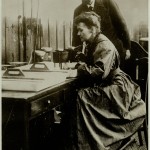
Marie Curie and her husband and lab partner, Pierre. From the Frank Hartman papers, MSS 2/340.
Early in the 20th century there was a medical practice that revolved around a new treatment involving the radioactive material called radium. After the discovery of radioactivity in 1896 by French physicist and Nobel Prize winner, Antoine Henri Becquerel, many other scientists began to search for uses of radioactivity. Becquerel would take Marie Curie under his tutelage as a doctoral student where they pursued the discovery of radium and other radioactive minerals. Only two years after Becquerel’s breakthrough, Marie Curie and her husband, Pierre Curie, discovered radium.
Marie Curie was a Polish-born and French-naturalized physicist and chemist, as well as the first woman in history to win the Nobel Prize, and the only woman to win twice. Marie would marry Pierre Curie, also a French Physicist and Nobel Prize winner. Marie and Pierre Curie found radium in a sample of uraninite in 1898. After the discovery, radium was used to cure many ailments.
With little to no regulation of radium and other treatments in the early 20th century, ambitious medical doctors and salesmen looked to make products using radium to cure many ailments. These products ranged from additives in toothpaste to “Revigator,” which was water with radium dissolved into it. Patients would drink from the container throughout the day to cure their ailments. By the 1940s and 50s, however, the practice of using radium as a medical treatment had been reduced to very few applications due to its high price, small quantity, and the dangers of handling radium.
The Historical Medical Library holds a variety of resources on radium, including the Frank Hartman papers. Hartman, a radium specialist and consultant, spent most of his life inspecting, selling, consulting, or hunting down and returning radium. As a “radium hound,” Hartman had firsthand experiences of dealing with and careful handling of radium in the early 20th century. Other resources include photographs, a scrapbook on Marie Curie, medical trade ephemera, and numerous books dealing with radium treatments and the development of radium-related cancer.
The links below will direct you to the catalog record or finding aid of the resource listed. Remember to check our library catalog and finding aids – these are only some of the great sources we have about radium as a medical treatment!
Primary sources
The Frank Hartman papers are a rich resource in studying radium as a medical treatment. Listed below are some of the highlights of the collection.
View the full finding aid: Frank Hartman papers
Call number: MSS 2/0340
Certificates and qualifications, 1893-1955: Birth certificate, military discharge papers, etc.
Frank Hartman radium services records, undated: Radium products, applications, and price lists
Radium diary, 1942-1956: Notes the importance of radium, dangers, proper handling, newspaper clippings, and radium hunting
Scrapbook, undated: “Do’s” and “do not’s” in handling radium
Lecture notes regarding the Radium Products Company, 1925-1940: Information on radioactivity
Notes regarding meeting with the Federal Bureau of Investigation to discuss investigation of radium sales in the 1930s,
Hazards of medical radiation, undated: Dangers of radiation
Radon ointment, 1944-1946: Later usage of radium in the form of radon ointment
Suplee broadcast, 1936: Transcript of interview with Hartman about radium
Villanova College presentations regarding radium handling, 1937-1939
Newspaper clippings regarding radium and issues of radioactivity, 1930-1976
Radium promotional materials, 1920s
Photographs
Marie Curie, International Congress of Physics, Rome, 1920
Marie Curie, visit to the United States, 1921: Marie Curie meeting President Harding
Marie Curie, announcement of death, 1934: Photos of Marie Curie days before her passing. She refused to stop doing research in her lab with the material that would eventually cause her death until she was finally admitted to a hospital.
Marie Curie, general photographs, undated
Young Marie Curie (Skłodowska), undated
Marie Curie with Pierre, undated
Irene Curie and Frederic Joliot, 1937
Marie Curie’s daughter and husband. Both Nobel Prize winners and part of the prolific family of science.
Curie family and history of radium (album), 1960-1963
Röntgen, Wilhelm Conrad, 1894. Röntgen discovered X-Rays (Röntgen Rays).
Radium City, Northwest Territory, 1934-1945. Mining operations for radium took place in the early 20th century.
We use cookies to ensure that we give you the best experience on our website. If you continue to use this site we will assume that you are happy with it.





 “Influenza and Epidemic Pneumonitis” from Medical Council
 History of United States Army Base Hospital No. 20