– by Patrick Magee, Visitor Services/Gallery Associate
As covered in previous Mütter Medicine Mondays posts, the cutting edge of medical treatment is rarely a place free from debate. A common theme found in emergent medicine is the trade-off: what inconveniences will be had, or sacrifices will be made, to improve one’s prognosis overall? Radiation and radium therapy remain at the forefront of these discussions due to their roles as diagnostic tools and treatments for maladies like cancer, but their medical uses present similar dilemmas to those seen throughout the world when other forms of nuclear energy are invoked.
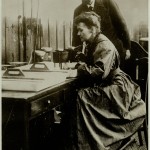
Marie Curie and her husband and lab partner, Pierre. From the Frank Hartman papers, MSS 2/340.
Early in the 20th century there was a medical practice that revolved around a new treatment involving the radioactive material called radium. After the discovery of radioactivity in 1896 by French physicist and Nobel Prize winner, Antoine Henri Becquerel, many other scientists began to search for uses of radioactivity. Becquerel would take Marie Curie under his tutelage as a doctoral student where they pursued the discovery of radium and other radioactive minerals. Only two years after Becquerel’s breakthrough, Marie Curie and her husband, Pierre Curie, discovered radium.
Marie Curie was a Polish-born and French-naturalized physicist and chemist, as well as the first woman in history to win the Nobel Prize, and the only woman to win twice. Marie would marry Pierre Curie, also a French Physicist and Nobel Prize winner. Marie and Pierre Curie found radium in a sample of uraninite in 1898. After the discovery, radium was used to cure many ailments.
With little to no regulation of radium and other treatments in the early 20th century, ambitious medical doctors and salesmen looked to make products using radium to cure many ailments. These products ranged from additives in toothpaste to “Revigator,” which was water with radium dissolved into it. Patients would drink from the container throughout the day to cure their ailments. By the 1940s and 50s, however, the practice of using radium as a medical treatment had been reduced to very few applications due to its high price, small quantity, and the dangers of handling radium.
The Historical Medical Library holds a variety of resources on radium, including the Frank Hartman papers. Hartman, a radium specialist and consultant, spent most of his life inspecting, selling, consulting, or hunting down and returning radium. As a “radium hound,” Hartman had firsthand experiences of dealing with and careful handling of radium in the early 20th century. Other resources include photographs, a scrapbook on Marie Curie, medical trade ephemera, and numerous books dealing with radium treatments and the development of radium-related cancer.
The links below will direct you to the catalog record or finding aid of the resource listed. Remember to check our library catalog and finding aids – these are only some of the great sources we have about radium as a medical treatment!
Primary sources
The Frank Hartman papers are a rich resource in studying radium as a medical treatment. Listed below are some of the highlights of the collection.
View the full finding aid: Frank Hartman papers
Call number: MSS 2/0340
Certificates and qualifications, 1893-1955: Birth certificate, military discharge papers, etc.
Frank Hartman radium services records, undated: Radium products, applications, and price lists
Radium diary, 1942-1956: Notes the importance of radium, dangers, proper handling, newspaper clippings, and radium hunting
Scrapbook, undated: “Do’s” and “do not’s” in handling radium
Lecture notes regarding the Radium Products Company, 1925-1940: Information on radioactivity
Notes regarding meeting with the Federal Bureau of Investigation to discuss investigation of radium sales in the 1930s,
Hazards of medical radiation, undated: Dangers of radiation
Radon ointment, 1944-1946: Later usage of radium in the form of radon ointment
Suplee broadcast, 1936: Transcript of interview with Hartman about radium
Villanova College presentations regarding radium handling, 1937-1939
Newspaper clippings regarding radium and issues of radioactivity, 1930-1976
Radium promotional materials, 1920s
Photographs
Marie Curie, International Congress of Physics, Rome, 1920
Marie Curie, visit to the United States, 1921: Marie Curie meeting President Harding
Marie Curie, announcement of death, 1934: Photos of Marie Curie days before her passing. She refused to stop doing research in her lab with the material that would eventually cause her death until she was finally admitted to a hospital.
Marie Curie, general photographs, undated
Young Marie Curie (Skłodowska), undated
Marie Curie with Pierre, undated
Irene Curie and Frederic Joliot, 1937
Marie Curie’s daughter and husband. Both Nobel Prize winners and part of the prolific family of science.
Curie family and history of radium (album), 1960-1963
Röntgen, Wilhelm Conrad, 1894. Röntgen discovered X-Rays (Röntgen Rays).
Radium City, Northwest Territory, 1934-1945. Mining operations for radium took place in the early 20th century.
Radiumtherapy
by Louis Wickham, 1910
Call number: Qgg 44.2
*Content written by Patrick Elgert, Temple University Cultural Fieldwork Initiative intern
We use cookies to ensure that we give you the best experience on our website. If you continue to use this site we will assume that you are happy with it.

 The Frank Hartman papers are a rich resource in studying radium as a medical treatment. Listed below are some of the highlights of the collection.