When the Black Death arrived in England in summer 1348, it had already hit China, middle Asia, the Crimea, and Sicily, and had begun moving inland to the rest of continental Europe. The death rate varied from region to region, but it is probably fair to say that it ranged from about 12% to 66% of the population. Some evidence points to the Black Death being the plague, a fever caused by the bacterium Yersinia pestis; while other evidence suggests it was viral in origin. Regardless of the cause, it was extremely infectious and caused upheaval for decades everywhere it hit.
Bernard de Gordon, in his Lilium medicinae, enumerates some signs of impending plague in the chapter entitled “Pestitential fevers.” Each chapter in Lilium is divided into 6 sections: the first included the definitions, names, and types; the second, the causes; the third, the diagnosis; the fourth, the prognosis; the fifth, the treatment; and finally, the sixth – the clarification. The following is a loose translation of a 1551 version of Lilium, from the second section of “Pestilential fevers.”
Cap[itulum] ix. De febribus pestilentialis f. 15v. Bernard de Gordon’s Lilium medicinae, 1348 (Oxford?). Call no. 10a 249.Read more
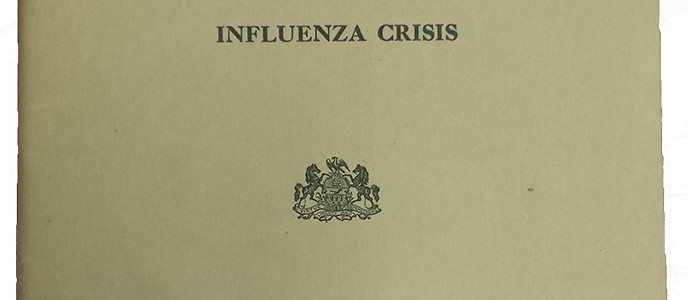
Pennsylvania Council of National Defense Department of Medicine, Sanitation and Hospitals. Emergency Service of the Pennsylvania Council of National Defense in the Influenza Crisis. Harrisburg, PA. 1918. Call number: Pam 173
The 1918 influenza pandemic did not hit the world all at once, but rather in three waves throughout 1918 and into 1919. Though it is unclear how the influenza pandemic influenced the outcome of World War I, what is undeniable is the pandemic’s connection to the war itself.
The first wave was in early 1918, and may have originated in Haskell County, Kansas, where “18 cases of influenza of a severe type” were reported in January and February. From Camp Funston in Fort Riley, Kansas, influenza travelled to Europe with soldiers going to the battlefront of World War I. The general population picked the disease up from the military, and by June, it was epidemic among the German troops and appearing among civilians in mainland Britain. While this first wave did substantial damage, it was milder than and not nearly as lethal as the second wave, which appeared as the first wave was fading in late August.
The second wave began when three cities on three separate continents experienced outbreaks of influenza almost simultaneously. Boston, Massachusetts in North America; Brest, France in Europe; and Freetown, Sierra Leone in Africa all had influenza appear in their naval yards between August 22 and August 27, 1918. The first cases of influenza in Philadelphia appeared on September 7, when sailors from Boston arrived in the naval yard. By early October, hospital beds in Philadelphia were full, public meetings and church services were banned, schools were closed, and there was a severe shortage of coffins. Beginning in September 1918 and until spring of 1919, the weekly number of influenza-related deaths in Philadelphia dropped below three figures only once. In October alone, over 11,000 Philadelphians died from influenza.
By the end of October, public services and meetings, including school and church, were re-opened. In early November, influenza in Philadelphia had reached its peak and the number of deaths slowly declined. A reported 12,162 people had died by November 2, 1918. The end of the second wave for most American cities, including Philadelphia, came in mid-November. Philadelphia had a small resurgence during the third and final wave during February 1919. By the end of the pandemic, a huge number of people had died. A general estimate for the total number of deaths is 50 million, though estimates range from as low as 25 million to as high as 100 million deaths worldwide. Over 1.5 million of these deaths were in the United States. Whichever way the true numbers run, the loss of life is truly astounding.
The links below will direct you to the catalog record or finding aid of the resource listed. Remember to check our library catalog and finding aids – these are only some of the great sources we have about the influenza pandemic!
Primary sources
Note: Some of these materials are uncatalogued and are not linked to a catalogue record. When requesting the uncatalogued materials, please be sure to include all of the information shown here.
The Pathology of Influenza
by M.C. Winternitz, Isabel M. Wason, and Frank P. McNamara, 1920
Call number: ZMm 4
*Content written by Carolyn Woodruff, Haverford College intern
We use cookies to ensure that we give you the best experience on our website. If you continue to use this site we will assume that you are happy with it.




 “Influenza and Epidemic Pneumonitis” from Medical Council
 History of United States Army Base Hospital No. 20