 When Dr. Katharine Rosenbaum Guest Boucot Sturgis was elected the first female president of the College of Physicians in 1972, it was one of only a series of firsts she had accomplished in her career as a physician, teacher, administrator, researcher, editor and consumer advocate. But Dr. Sturgis did not see herself as having accomplished anything special just because she was a woman. She once reflected, “I never looked at people as men or women or black or white.” Dr. Sturgis had great respect for all people while never complaining about how she had to compete and, ultimately, thrive in the male-dominated medical profession which she chose as her vocation.
She was born Katharine Rosenbaum in Philadelphia, Pennsylvania in 1903, and, at a young age, decided to pursue a medical career. She had to convince her skeptical father that medicine was a feasible vocation for a young woman. This was no small feat in an era where women were expected to be homemakers and not much else in the male-centric society in which she grew up. Not to be deterred, she convinced her father by making a dress from scratch with him knowing full-well that she despised sewing. Her father then relented and allowed her to attend college to study pre-med.
Katharine Sturgis, despite a debilitating two-year bout with tuberculosis which landed her in a sanitarium, eventually earned her medical degree from Woman’s Medical College of Pennsylvania in 1942. Of her time at Woman’s Medical, despite her raising her two children alone, she once reminisced, “I never was given one iota of extra consideration, and I think that’s why I broke down with TB. I had to do everything everyone else did. There was no quarter shown.” This dogged determination to accomplish her goals despite obvious hardships would serve Dr. Sturgis well throughout the rest of her career.
While doing her residency at Herman Kiefer Hospital in Detroit, Dr. Sturgis came to the realization that research was her calling. She once reflected upon the neglect of research in the medical field, “Unfortunately, neither our profession nor the public has yet recognized the fact that we will never have enough clinicians for the sick unless we turn off the parade of illness.” Dr. Sturgis was to leave an indelible mark on the field of medical research before her career was over.
Dr. Katharine Sturgis’ years of research into lung cancer resulted in advances that came as a result of her participation in such projects as the Philadelphia Pulmonary Research Project. She was later to become a resolute advocate for cleaning up air pollution as well as an active naysayer on the dangers of smoking and its direct correlation to lung cancer. Dr. Katharine effectively lobbied for cleaner air standards from state and federal authorities while she served as the first woman president of the Philadelphia County Medical Society.
After serving as a board member of the College of Physicians since 1951, Dr. Sturgis’ tenure as president was short-lived due to health considerations. However, she left an ineffaceable mark on the College for her determined fundraising efforts and serving as chairperson of the Bicentennial Committee.
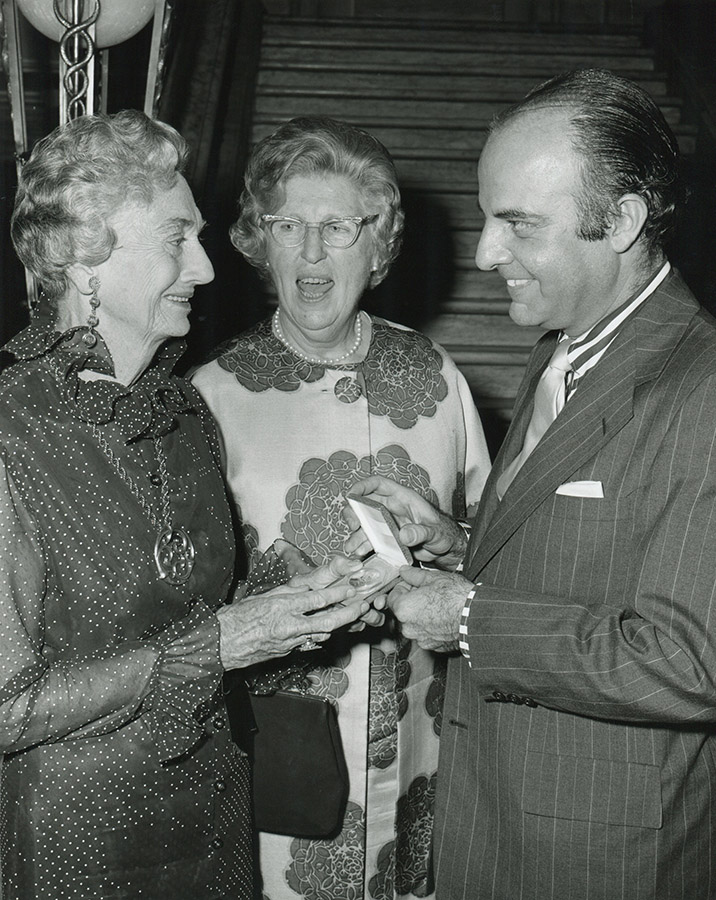
Dr. Sturgis’ awards and honors are too innumerable to mention, but two most precious to her were the prestigious Trudeau Award and her recognition as an Honorary Life Member of the American Lung Association in 1973. While reflecting upon her long and distinguished career in 1977, Dr. Sturgis humbly spoke, “I don’t kid myself that my career has made any major contributions to medicine, but as far as I am personally concerned, I’ve loved every minute of what I’ve done. I only wish I had more years in the field I love so much.” Dr. Katharine Sturgis was an exceptional doctor, advocate, teacher and researcher.
The Library of the College of Physicians contains a treasure trove of information on the life of Dr. Katharine R. Sturgis, a life that spanned such historically significant events as World War II, The Civil Rights Movement, the Vietnam War, and the United States Bicentennial. By researching her personal letters, correspondence, and newspaper articles, a student will get a real sense of how history unfolded through the words of such an outstanding person as Katharine R. Sturgis.
The links below will direct you to the catalog record or finding aid of the resource listed. Remember to check our library catalog and finding aids – these are only some of the great sources we have about Dr. Katharine Sturgis!
Primary sources
 Katharine R. Sturgis Papers, 1948-1979
Call number: MSS 2/0355-01
General Correspondence of Katharine R. Sturgis, 1972-1974
Call number: CPP 2/002-02
Presidential Papers of Katharine Sturgis, 1970-1974
Call number: CPP 2/002-01
 In Her Own Words: Oral Histories of Women Physicians
By Regina Markell Morantz-Sanchez, 1982
Call number: WZ 150 I35 1982
Secondary sources
Tuberculosis Medical Research: National Tuberculosis Association, 1904-1955
By Virginia Cameron, 1959
Call number: WF 1 NC277
Antibiotics and Antibiotic Therapy: A Clinical Manual
By Allen Elemer Hussar, 1954
Call number: QB 511
*Content written by Mike Mooney, Temple University Cultural Fieldwork Initiative intern


